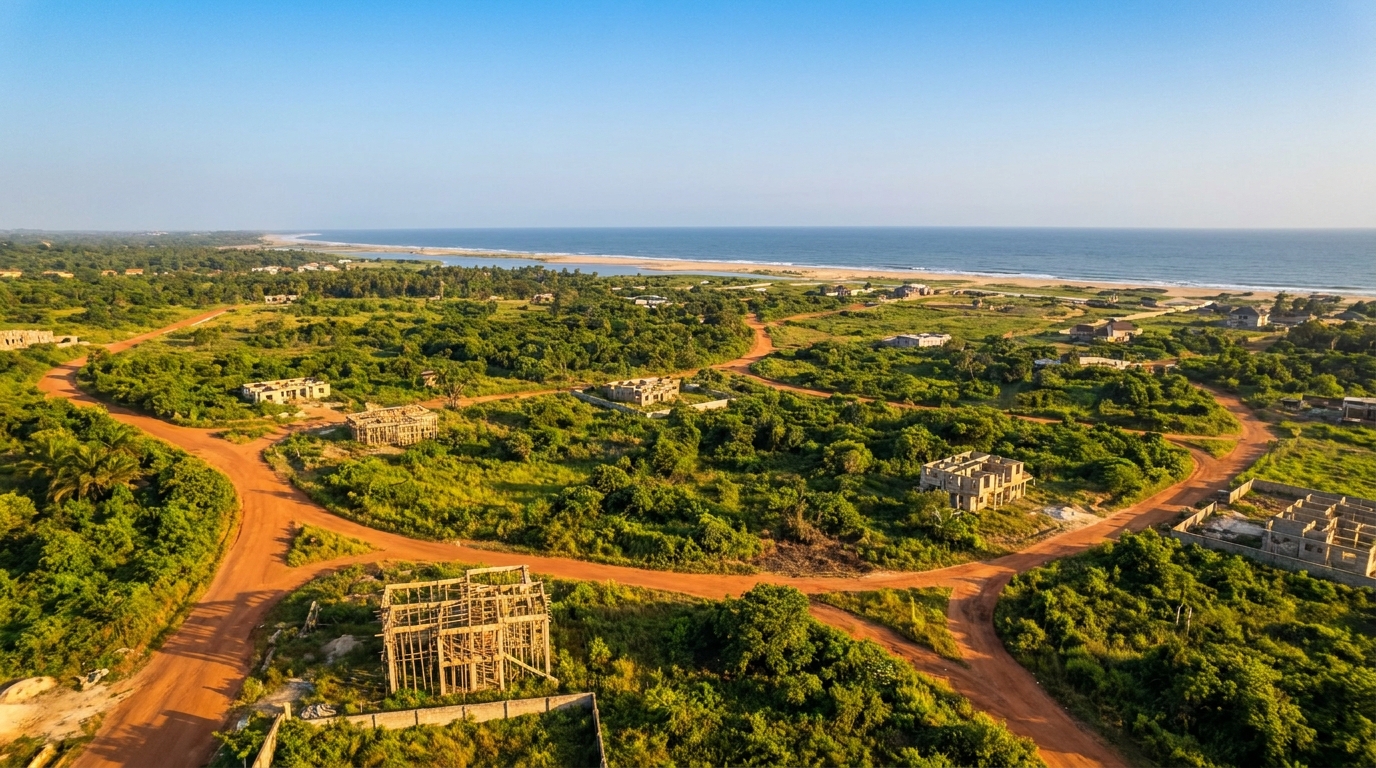
Every seasoned Lagos investor has a story about the friend who bought land in Lekki "when it was bush" and watched the neighbourhood transform around them. That story is told so often it has become almost mythological — but the underlying logic is not magic. Lekki's rise followed a pattern: deliberate infrastructure investment, employer arrivals, improved road connectivity and large-scale government-backed projects that gave private capital the confidence to follow. Understanding that pattern is far more useful than chasing the myth.
The good news is that the same signals are visible today, in several corridors across Nigeria, if you know what to look for. The difficult news is that spotting a promising corridor is only half the work. Verifying title, confirming layout approval and checking physical access are what separate a sound investment from an expensive lesson. This article walks you through both sides of that equation.
How Lekki Actually Grew
Lekki's transformation was not spontaneous. A sequence of enabling conditions arrived over roughly two decades, and each one lowered the perceived risk for the next wave of buyers.
- Road infrastructure. The Lekki-Epe Expressway gave the peninsula a reliable spine. Without it, the distance from Lagos Island would have remained prohibitive for daily commuters and businesses alike.
- Employer anchors. Oil-and-gas companies, banks and professional-services firms established offices along the corridor, creating a workforce that needed nearby housing.
- Planned estates and gated communities. Developers who could offer documented titles and serviced plots attracted buyers who might otherwise have stayed on the Island, gradually normalising the area for a wider market.
- The Lekki Free Trade Zone. The announcement and gradual development of the free zone signalled long-term government commitment to the axis, which in turn attracted industrial and logistics tenants.
- Institutional confidence. Once international brands, hotels and retail centres arrived, the corridor crossed a psychological threshold. Prices reflected not just current utility but anticipated future demand.
No single factor did the work alone. It was the convergence of several signals — infrastructure, employers, planned development and government backing — that compounded over time.
A Framework for Spotting the Next Corridor
Rather than guessing based on rumour or social-media hype, disciplined investors look for a cluster of the following conditions. The more boxes a corridor ticks, the more credible its growth thesis becomes — though ticking boxes is never a guarantee of outcome.
1. Anchor Infrastructure Under Construction or Committed
A road, bridge, port, rail line or power project that is funded, contracted and visibly under way is far more meaningful than one that exists only in a government press release. Look for projects where ground has been broken and contractors are on site.
2. Employer or Industrial Anchors
A free zone, industrial park, university, hospital or large employer draws workers who need housing. Ask: who will actually live or work here, and can they afford to rent or buy nearby?
3. Government Layout Approval Activity
When a state government begins approving layouts and issuing survey plans in an area, it is a strong signal that the corridor is being formally integrated into the urban plan. This also makes title verification more straightforward.
4. Improving Physical Access
A corridor that is theoretically close to a city but practically unreachable during rain or traffic is not yet investable for most buyers. Watch for road rehabilitation, bridge construction or public-transport extensions that reduce effective travel time.
5. Early Private Developer Interest
When reputable, documented developers — not just roadside plot sellers — begin acquiring and servicing land in an area, it suggests they have done their own feasibility work. That is a useful, though not infallible, signal.
Corridors Worth Researching in Lagos
The Ibeju-Lekki Axis
This is the most widely discussed candidate for the next Lekki, and for reasons that are publicly documented rather than speculative. The Lekki Deep Sea Port, which has been reported as one of the largest port investments in West Africa, is operational. The Dangote Refinery complex — one of the largest single-train refineries in the world — is located on this axis. The Lekki Free Trade Zone continues to attract industrial tenants.
Ibeju-Lekki land sits further along the Lekki-Epe Expressway than most Lagosians have historically ventured, which is precisely why prices have, until recently, remained accessible relative to established Lekki. The infrastructure story is real. The caution is equally real: parts of the axis still lack reliable road surfaces, drainage and utility connections, and title irregularities remain a documented risk in areas that were farmland until recently. Anyone researching this corridor should treat it as a long-horizon position, not a short-term trade.
The Epe Township and Surrounds
Epe has long been overlooked despite sitting on the Lagos Lagoon with a functioning town centre. Improved road links along the Lekki-Epe Expressway have reduced travel times, and the broader Ibeju-Lekki development is pulling commercial activity eastward. It warrants research, particularly for buyers interested in residential or mixed-use land.
Corridors Worth Researching Beyond Lagos
Abuja's Outer Growth Rings
Abuja's master plan has always anticipated outward expansion, and several satellite towns and districts — including areas along the airport road corridor and districts to the south and east of the city — have seen documented infrastructure investment and estate development. The Federal Capital Territory Authority periodically releases new layouts, which is worth monitoring through official channels.
Port Harcourt's Expanding Periphery
Nigeria's oil capital continues to attract industrial and professional workers. Areas on the outskirts of the city, particularly those with improving road access and proximity to industrial zones, are worth examining for residential land investment, though buyers should be especially diligent about community land rights and state land-use compliance in Rivers State.
The Due Diligence You Cannot Skip
Identifying a promising corridor is the beginning, not the end. In Nigeria's property market, the gap between a promising location and a safe investment is bridged entirely by documentation. Before paying any deposit, confirm the following:
- Title document. Is the land covered by a Certificate of Occupancy (C of O), a Deed of Assignment with Governor's Consent, or a registered Gazette? Understand what you are buying and what rights it confers.
- Survey plan. Obtain a registered survey plan and verify the beacon numbers with the state Surveyor-General's office.
- Independent search at the Lands Registry. Do not rely on documents shown to you by the seller. Conduct your own search to confirm there are no encumbrances, disputes or double allocations.
- Layout approval. Confirm that the estate or layout has been approved by the relevant state ministry. Unapproved layouts can be demolished or denied utility connections.
- Physical inspection. Visit the land in person, ideally during and after rainfall, to assess drainage, road access and the actual state of infrastructure.
- Legal advice. Engage a qualified Nigerian property lawyer — not the developer's in-house counsel — to review all documents before you sign.
At Royal Beacon, transparent documentation sits at the centre of every listing. Whether you are looking to own a plot outright or explore fractional property ownership — which allows you to hold a stake in a larger asset without buying an entire plot — every property on the platform is accompanied by clear title information so you can conduct your own verification.
Managing Expectations in the Current Climate
Nigeria's macroeconomic environment has shifted considerably in recent years. The naira's move to a floating exchange rate in June 2023 — when the official rate stood at roughly N464 to the dollar — and its subsequent adjustment to around N1,535 by the end of 2024 have reshaped the calculus for both naira-denominated and dollar-linked property transactions. Meanwhile, headline inflation, which the National Bureau of Statistics recorded at 23.14% in August 2025, had moderated to 15.39% by August 2026 — a meaningful improvement, though still a significant cost-of-living consideration for buyers.
These conditions mean that property can serve as a store of value in a high-inflation environment, but they also mean that carrying costs, construction materials and financing are all more expensive than they were a few years ago. Invest with a clear understanding of your time horizon, your liquidity needs and the specific risks of the corridor you are entering.
Making a Considered Decision
The next Lekki almost certainly exists somewhere along Nigeria's expanding urban corridors. Whether it is on the Ibeju-Lekki axis, around Epe, in Abuja's outer districts or in another city entirely, the framework for identifying it is consistent: look for committed infrastructure, employer anchors, government layout activity and improving access — then verify every document before you commit a naira.
If you are ready to explore specific opportunities, browse our properties to see what is currently available with documented titles across Lagos and beyond. If you would prefer to talk through your options first, speak to the team at Royal Beacon — we are here to help you invest with clarity, not pressure.
This article is provided for general information purposes only and does not constitute financial, legal or investment advice. Property investment carries risk, including the risk of loss of capital. Past performance of any location or asset class is not a reliable indicator of future results. Always seek independent legal and financial advice before making any investment decision.