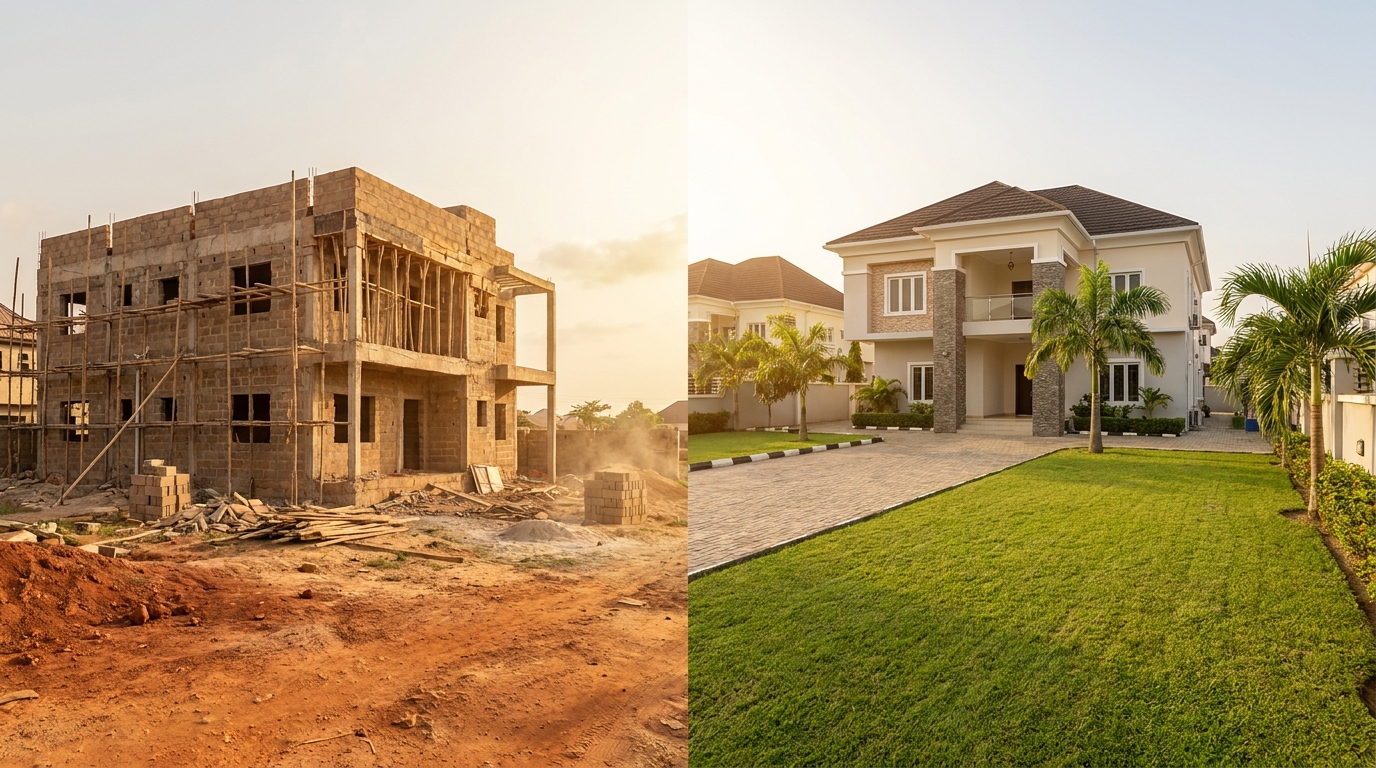
Buying property in Nigeria is rarely a straightforward decision, and one of the earliest forks in the road is this: do you buy off-plan — committing your money before the building exists — or do you wait and pay for something you can already walk through? Both routes have genuine merit, and both carry real risks that deserve honest examination before you sign anything.
This article does not tell you which option is right for you. It lays out the trade-offs as clearly as possible, flags the due-diligence steps that matter most in the Nigerian context, and gives you a framework for making a decision that fits your financial situation, your risk appetite and your timeline.
What "Off-Plan" Actually Means in Nigeria
Off-plan property — sometimes called buying property under construction — means you are purchasing a unit or plot based on architectural drawings, a scale model or a developer's brochure, before the structure is complete or, in some cases, before a single block has been laid.
In Nigeria, off-plan sales are common across residential estates, gated communities and mixed-use developments in cities such as Lagos, Abuja, Port Harcourt and Enugu. Developers use early sales to raise construction capital, and buyers are typically offered a lower entry price in exchange for accepting that risk.
What "Completed Property" Means
A completed property is one that is structurally finished, has received the necessary regulatory sign-offs and — ideally — already has a clean title document in place. It may be brand new from a developer or a resale from a private owner.
You can inspect it physically, verify the quality of finishes, check the neighbourhood at different times of day and, if it is a rental unit, potentially begin earning income almost immediately after purchase.
The Case for Off-Plan: Lower Entry, Longer Wait
The most obvious attraction of off-plan property nigeria buyers cite is price. Developers typically price early-stage units below what they expect to charge at completion, partly to reward early commitment and partly to fund construction. This spread can be meaningful, though how meaningful it turns out to be depends entirely on how the market moves between your purchase date and handover — and that is never certain.
There is also a payment-flexibility argument. Many off-plan schemes allow staged payments tied to construction milestones, which can make a purchase accessible to buyers who cannot produce the full sum at once.
However, the risks are real and specific:
- Construction delays. Building timelines in Nigeria are routinely affected by materials costs, foreign-exchange volatility, contractor capacity and regulatory approvals. When the Central Bank of Nigeria moved to a floating exchange rate on 14 June 2023, the official rate stood at roughly ₦464 to the US dollar. By the end of 2024 it had reached approximately ₦1,535. Developers who priced imported materials at the earlier rate faced severe cost pressures, and some projects stalled or were repriced mid-construction. That environment has eased somewhat — Nigeria's headline inflation was 15.39% in August 2026, down from 23.14% a year earlier according to the National Bureau of Statistics — but cost volatility remains a structural feature of the market.
- Developer default or insolvency. If a developer runs out of funds or exits the market, buyers can find themselves with neither a property nor an easy path to recovering their money.
- Quality uncertainty. You cannot inspect what does not yet exist. Finishes, structural quality and estate infrastructure may differ from what was shown in the brochure.
- Title delays. Even after physical completion, obtaining a Governor's Consent or Certificate of Occupancy on individual units in a large estate can take considerably longer than buyers expect.
The Case for Completed Property: Clarity at a Premium
Completed property costs more — sometimes significantly more — than the same unit would have cost off-plan. That premium, however, buys you something valuable: certainty.
You can inspect the structure, check for cracks, dampness or substandard finishes, verify that the estate roads and drainage actually exist, and confirm that utilities are connected or connectable. If you are buying as an investment, a tenant can move in quickly, meaning your rental income timeline is clear.
Due diligence is also more straightforward. The title document exists and can be verified at the relevant State Lands Registry. A licensed surveyor can confirm that the survey plan matches the physical boundaries. A property lawyer can conduct an independent search to check for encumbrances, government acquisition notices or competing claims — steps that are harder to complete meaningfully on a plot that is still being developed.
The trade-offs to acknowledge:
- The higher price means a larger upfront capital requirement or a bigger mortgage.
- In a fast-moving market, the best-located units in a completed development may already be sold.
- Older completed properties may carry maintenance costs or structural issues that a survey will reveal.
Practical Checks for Off-Plan Buyers
If you decide that off-plan property nigeria is the right route for you, the following checks are not optional — they are the minimum standard of care.
- Verify the developer's track record. Ask for completed projects you can physically visit. Speak to residents or past buyers if possible. A developer with a portfolio of delivered projects is meaningfully different from one whose only evidence is a render.
- Insist on a structured payment plan tied to milestones. Avoid arrangements where you pay a large percentage upfront before any construction has started. Payments linked to verifiable stages — foundation, roofing, finishing — give you leverage and reduce your exposure if work stalls.
- Ask about escrow or a dedicated project account. Some reputable developers in Nigeria hold buyer funds in a dedicated account that can only be drawn down as construction progresses. This is not yet universal practice, but it is worth asking about and negotiating for.
- Review the contract carefully with a property lawyer. Confirm what happens if the developer misses the projected handover window, what remedies you have and how disputes are resolved. Be cautious of contracts that give the developer unlimited time to complete.
- Check the land title before you pay anything. The developer should be able to show you a Certificate of Occupancy or a registered deed of assignment on the underlying land. If the title is unclear, your own title will be too.
- Conduct an independent search at the Lands Registry. Do not rely solely on documents the developer provides. A lawyer or accredited search agent can confirm whether the land is free of government acquisition, court orders or other encumbrances.
- Be realistic about timelines. No completion date in an off-plan contract should be treated as a guarantee. Build a personal buffer into your plans — financial and logistical — for a project that takes longer than projected.
Practical Checks for Completed-Property Buyers
- Commission an independent structural survey before exchanging contracts.
- Verify the title document type (Certificate of Occupancy, Governor's Consent, Deed of Assignment) and confirm it is registered.
- Conduct a search at the relevant State Lands Registry.
- Confirm that Governor's Consent has been obtained or will be obtained as part of the transaction — this is a legal requirement for most transfers of leasehold interests in Nigeria.
- Check whether the property falls within any government acquisition or right-of-way corridor.
- Inspect the estate's shared infrastructure: roads, drainage, water supply, security and waste management.
Matching the Choice to Your Situation
Neither route is universally better. A rough illustration — not a forecast — helps frame the decision: if you are a diaspora investor with a five-year horizon, sufficient liquidity to absorb a delay and a developer whose track record you have verified, off-plan property under construction may offer a meaningful entry-price advantage. If you need rental income within the next twelve months, or if your capital is limited and a delay would cause financial strain, a completed property's higher price may represent better value for your specific circumstances.
At Royal Beacon, our approach is built around transparent documentation at every stage — whether a client is buying a completed home outright or participating in fractional property ownership through our platform. We believe the right property is the one whose risks you fully understand before you commit.
Making a Confident Decision
The off-plan versus completed debate in Nigerian real estate does not have a single right answer. It has a right answer for you, based on your capital, your timeline, your tolerance for uncertainty and the quality of the specific developer or seller you are dealing with.
Take the time to do the legal and physical checks described above. Work with professionals — a registered property lawyer and a licensed surveyor — who are independent of the seller. And make sure the documentation trail is complete before any money changes hands.
If you would like to explore specific opportunities, you are welcome to browse our current properties or speak directly with the Royal Beacon team about what fits your goals.
This article is provided for general information purposes only and does not constitute financial, legal or investment advice. Property values can fall as well as rise, and past market conditions are not a reliable guide to future performance. Please consult a qualified property lawyer and a licensed financial adviser before making any investment decision.