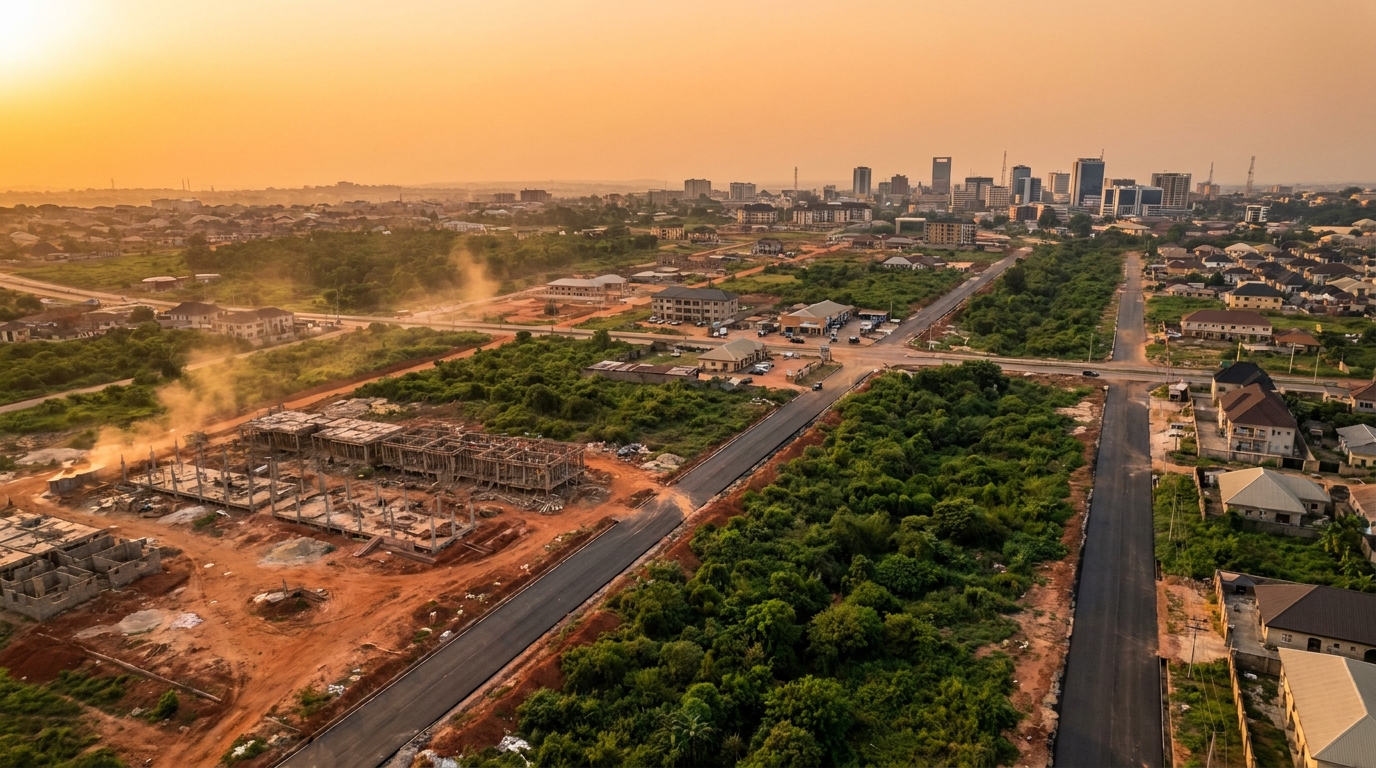
Every experienced property investor will tell you the same thing: the best time to enter a market is before everyone else realises it is a market. By the time a city appears on the front page of a business newspaper, the easy gains have usually been captured by those who were watching quietly — and patiently — years earlier.
The good news is that fast-growing cities do not appear overnight. They send signals, sometimes for a decade before prices reflect them. Learning to read those signals is one of the most valuable skills you can develop as a property investor in Nigeria. This article gives you a practical framework for doing exactly that — so you can make informed, eyes-open decisions about where to buy land in Nigeria before the crowd arrives.
1. Start With People: Population and Migration Trends
Cities grow because people move to them. Before you look at a single plot, ask yourself: who is moving here, and why?
Internal migration in Nigeria is largely driven by economic opportunity. When a town begins attracting workers from surrounding states — or when a significant share of its residents are young adults rather than retirees — that is a meaningful early signal. Look for:
- A rising proportion of working-age residents relative to dependants
- Visible in-migration from neighbouring states or rural areas
- Growing demand for rental accommodation, even modest rooms
- New market activity: traders setting up, informal commerce expanding
Official census data can be slow to reflect reality, so complement it with ground-level observation. Are bus parks busier than they were two years ago? Are new schools being built to absorb children? These qualitative markers often precede the statistics.
2. Follow the Infrastructure
No city grows without infrastructure, and infrastructure projects are usually announced publicly — sometimes years before completion. This gives attentive investors a genuine head start.
Roads and Highways
A new federal or state road linking a secondary town to a major commercial hub can compress travel time dramatically. When commuting becomes practical, land values along that corridor typically respond.
Rail
Rail projects in Nigeria have historically been slow to deliver, but where they do arrive — or where credible construction is visibly under way — they tend to anchor long-term urban expansion around stations and terminals.
Airports and Ports
A new or upgraded airport signals that the federal or state government expects significant economic activity. Inland ports and dry ports attract logistics businesses, warehousing and light manufacturing — all of which create employment and housing demand.
Power
Reliable electricity is a quiet but powerful growth catalyst. When an industrial zone or a new city district secures a dedicated power supply — whether from the national grid or an embedded generation project — businesses follow. Businesses bring workers. Workers need homes.
The practical rule: check government gazette notices, state ministry announcements and the Federal Ministry of Works website for infrastructure projects that are funded and contracted, not merely proposed.
3. New Employers, Free Zones and Industrial Activity
A single large employer can transform a sleepy town. A free-trade zone or special economic zone can transform an entire corridor. When a federal or state government gazetted a free zone in a location, it is signalling its intention to attract foreign and domestic investment to that area.
Watch for:
- Announcements of manufacturing plants, agro-processing facilities or logistics hubs
- Free-zone designations or export-processing zone licences
- Large-scale agricultural schemes that need processing infrastructure nearby
- Technology or business-process outsourcing campuses
Each of these creates a cluster of employment, and employment clusters generate demand for housing at every price point — from workers' quarters to mid-range family homes to executive rentals.
4. University and Hospital Anchors
Education and healthcare institutions are among the most reliable long-term anchors for urban growth. A federal or state university generates thousands of students, lecturers and support staff who need accommodation. Teaching hospitals attract medical professionals, patients and their families from wide catchment areas.
These institutions also tend to attract secondary businesses — pharmacies, restaurants, printing shops, private schools — that further densify an area. When a new university campus or a major hospital is commissioned in a town that previously lacked one, the surrounding land market often begins to stir within a few years.
5. Government Master Plans and Development Corridors
Every state in Nigeria has a ministry responsible for physical planning. Many have published master plans or development frameworks that designate growth corridors, new town sites or industrial districts. These documents are public records, and reading them is one of the most underused research tools available to investors.
Look for:
- Officially designated new town or satellite city projects
- Zoning changes that reclassify agricultural land to residential or commercial use
- Announced government administrative relocations (a new secretariat or government house often anchors surrounding development)
- Special development authority mandates
When a state government commits capital expenditure to a corridor — roads, water, drainage — it is, in effect, de-risking that corridor for private investment. At Royal Beacon, part of our process involves reviewing the planning status and documentation of every property we list, so that buyers understand what the land is legally designated for and what the surrounding development context looks like.
6. Early-Warning Signs That a Market Has Already Peaked
Knowing when not to buy is just as important as knowing when to buy. Several patterns suggest a market may have already priced in its growth — or worse, that it is running on speculation rather than fundamentals.
- Vacant developments: Large estates or blocks of flats sitting empty for years after completion suggest that supply has outrun genuine demand.
- Speculative pricing disconnected from local incomes: If land prices in an area cannot be justified by the rental income or economic activity actually present, the market may be driven by investor sentiment rather than underlying demand.
- Rapid price doubling without corresponding infrastructure delivery: When prices have risen sharply but the promised road, rail or employer has not materialised, caution is warranted.
- Oversupply of similar product: Multiple developers building identical mid-range estates in the same corridor simultaneously can create a glut that suppresses returns for years.
Nigeria's currency environment adds another layer of complexity. Since the Central Bank moved to a floating exchange rate in June 2023 — when the official rate was roughly ₦464 to the dollar — the naira has depreciated significantly, reaching approximately ₦1,535 to the dollar by the end of 2024. This has affected the real cost of building materials and the purchasing power of domestic buyers. Meanwhile, headline inflation, though easing — it stood at 15.39% in August 2026, down from 23.14% a year earlier, according to the National Bureau of Statistics — remains a factor in how buyers and sellers price assets. Understanding this macroeconomic backdrop helps you assess whether a price increase in a given area reflects genuine growth or simply naira depreciation.
7. On-the-Ground Due Diligence: The Nigerian Essentials
Identifying a promising city is only the beginning. Before committing any funds, carry out rigorous due diligence on the specific property. In Nigeria, this means:
- Verify the title document. A Certificate of Occupancy (C of O) issued by the state government is the strongest form of title. Understand what you are buying — a C of O, a deed of assignment, a governor's consent, or a less formal document — and what each means for your security of tenure.
- Obtain a survey plan prepared by a registered surveyor and confirm that the coordinates do not fall within a government acquisition or committed area.
- Conduct an independent search at the state lands registry to confirm the vendor's ownership and check for encumbrances, mortgages or disputes.
- Confirm Governor's Consent is obtained or will be obtained on any assignment of a leasehold interest, as required under the Land Use Act.
- Engage a qualified property lawyer to review all documents before you sign or pay.
At Royal Beacon, we believe transparent documentation is not a luxury — it is the foundation of any sound property transaction. Whether you are purchasing outright or exploring fractional ownership of a property, understanding exactly what title you are acquiring protects your investment for the long term.
8. Putting It All Together
No single signal is sufficient on its own. The most compelling emerging cities property investment opportunities are those where multiple factors converge: people are moving in, infrastructure is being delivered, employers are arriving, anchor institutions are present, and government plans support continued growth — all before prices have fully reflected that trajectory.
Build a simple checklist. Visit the location if you can. Speak to local residents, traders and landlords. Cross-reference what you hear with publicly available planning documents and infrastructure announcements. And always, always complete proper legal due diligence before you commit.
Property investment in Nigeria carries real risks — currency volatility, title disputes, infrastructure delays and policy changes among them. The framework above does not eliminate those risks, but it gives you a structured, evidence-based way to assess them before you invest.
If you would like to explore properties that have been through rigorous documentation review, or if you are curious about fractional ownership as a way to enter the market at a lower capital threshold, we invite you to browse our current properties or speak to the Royal Beacon team. We are happy to walk you through what we look for — and what we walk away from.
This article is provided for general information purposes only and does not constitute financial, legal or investment advice. Property investment involves risk, including the possible loss of capital. Readers should seek independent legal and financial advice before making any investment decision.