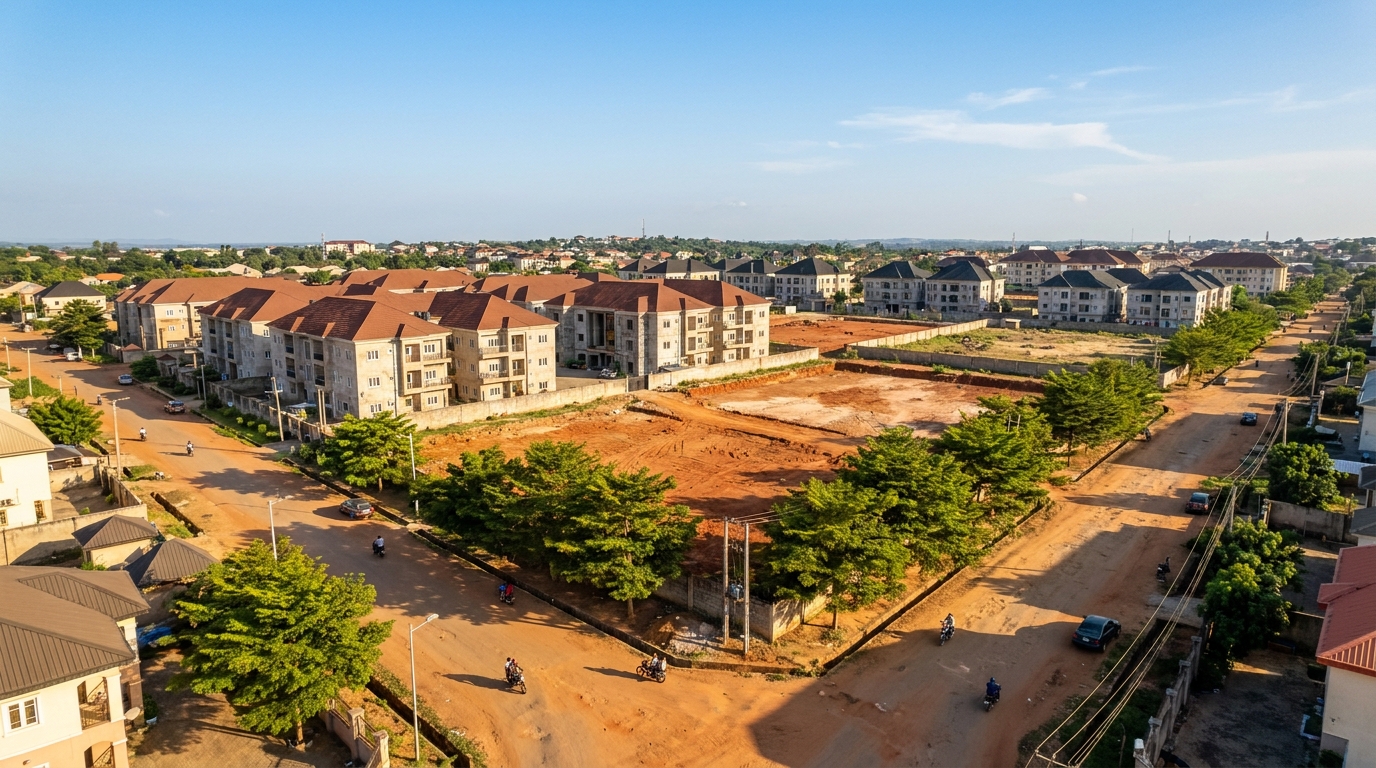
There is a saying that has circulated Nigerian households for generations: "Buy land — they are not making any more of it." It is the kind of wisdom that sounds almost too simple, yet generation after generation of Nigerian families has quietly built its financial foundation on parcels of earth rather than on spreadsheets or stock certificates. The reasons are not mystical. They are rooted in economics, human behaviour, and the specific realities of a fast-urbanising country of more than 200 million people.
This article is not a pitch. It is an honest look at why land has been such a durable wealth-builder for Nigerian investors, where the genuine risks lie, and what practical steps protect you before you part with a single naira.
The Scarcity Principle: Why Land Holds Its Ground
Every other asset class can be manufactured in greater quantities. A company can issue more shares. A government can print more currency — and in Nigeria, the consequences of that are vivid. When the Central Bank of Nigeria moved to a floating exchange rate on 14 June 2023, the official rate stood at roughly ₦464 to the US dollar. By the end of 2024, that same dollar cost roughly ₦1,535. Savings held in naira lost a significant portion of their purchasing power in under eighteen months.
Land cannot be printed. The total supply of developable land in Lagos, Abuja, Port Harcourt or any other Nigerian city is fixed. As populations grow and urban boundaries expand outward, demand presses against that fixed supply. This is the foundational reason why well-located land tends to preserve — and over long periods, grow — its real value even as the currency around it weakens.
Compounding Appreciation Over Long Holding Periods
The most powerful feature of land as a wealth-building tool is not what it does in a single year. It is what happens when you hold it across a decade or more. Appreciation in land value tends to compound quietly: each year's gain becomes the base on which the next year's gain is calculated.
Consider this as an illustration only, not a forecast: if a plot purchased in an emerging corridor appreciates modestly in real terms over fifteen years, the cumulative effect can be substantial — not because any single year was dramatic, but because time multiplied each incremental gain. This is land banking in its purest form. The discipline is simply to buy in a credible location, secure the correct documentation, and hold.
The challenge, of course, is that most people find holding difficult. Life creates pressure to liquidate. This is why land investment in Nigeria rewards patient investors — and why it is not the right vehicle for money you may need at short notice.
Low Running Costs Compared with Operating a Business
Running a business in Nigeria demands constant attention: staff, overheads, regulatory compliance, customer acquisition, and the daily management of cash flow in an environment where inflation was still running at 15.39% as of August 2026, according to the National Bureau of Statistics. Even as that figure has come down from 23.14% a year earlier, the cost pressures on Nigerian businesses remain real.
A bare plot of land, by contrast, has almost no running costs. There is no payroll, no electricity bill, no inventory to manage. The primary ongoing obligations are:
- Ground rent or land use charges, which vary by state and are typically modest relative to the asset's value.
- Maintenance of boundaries, to prevent encroachment — a genuine concern in fast-developing areas.
- Keeping documentation current, including ensuring that any transfer of title is properly registered.
This passivity is both land's greatest strength and one of its limitations. It does not demand your time, but it also does not generate income unless you develop it or lease it.
An Honest Comparison with Running a Business
It would be misleading to suggest that land is simply superior to business as a wealth-building path. A well-run business can generate returns that far outpace property appreciation. It can create employment, build brand equity, and compound value through reinvestment of profits in ways that a static plot cannot.
The honest comparison looks something like this:
- Business can out-earn land significantly, but it requires active management, carries the risk of failure, and is exposed to competition, regulation and economic cycles.
- Land is largely passive, has low running costs, and tends to preserve value over long periods — but it is illiquid, generates no cash flow in its raw state, and its value depends heavily on location and title integrity.
Many of Nigeria's most financially secure families hold both: a business that generates income today, and land that stores and grows wealth over decades. The two are not rivals. They serve different roles in a portfolio.
It is widely believed — though not a verified statistic — that land ownership has been one of the most common routes to intergenerational wealth in Nigeria. Whether or not that belief holds up to rigorous data, the underlying logic is sound: land is hard to destroy, hard to steal if properly documented, and impossible to inflate away.
The Nigerian Caveats: Title, Survey and Governor's Consent
None of the above matters if you buy the wrong piece of land in the wrong way. Nigeria's land market has genuine risks, and they are concentrated almost entirely in the documentation process. Here is what every buyer must verify:
- Title document: The strongest form of title in Nigeria is a Certificate of Occupancy (C of O), issued by the state government under the Land Use Act. A registered Deed of Assignment is also acceptable, provided it traces back to a valid root of title. Be cautious of informal receipts or community letters that have no legal backing.
- Survey plan: A registered survey plan, prepared by a licensed surveyor and filed with the state's Office of the Surveyor-General, confirms the exact boundaries and coordinates of the land. It also reveals whether the land falls within government acquisition areas — a critical check.
- Governor's Consent: Under the Land Use Act, any transfer of an interest in land requires the consent of the state Governor (or their delegated authority). Without this consent, a transaction may not be fully enforceable. Ensure that consent is obtained and registered, not merely promised.
- Independent search at the Lands Registry: Before completing any purchase, commission an independent search at the relevant state Lands Registry. This confirms who holds the current registered interest and whether there are any encumbrances, disputes or government acquisitions on the land.
- Physical inspection and boundary verification: Visit the land in person. Engage a licensed surveyor to confirm that the physical boundaries match the survey plan. Encroachment disputes are common in high-growth corridors.
At Royal Beacon, transparent documentation is central to how we operate. Every property listed on landx.com.ng is presented with its title status clearly stated, because we believe buyers deserve to know exactly what they are acquiring before they commit.
Land Banking: The Long Game
Land banking — buying land in emerging or peri-urban areas and holding it as the surrounding area develops — is one of the most accessible forms of land investment in Nigeria. It does not require construction capital or development expertise. It requires research, patience, and rigorous due diligence.
The key variables to assess when considering a land banking strategy are:
- Infrastructure trajectory: Is government or private investment moving towards this corridor? Roads, bridges, rail lines and industrial zones tend to pull development — and land values — in their direction.
- Population pressure: Which cities and satellite towns are absorbing the most growth? Demand for land follows people.
- Title clarity: Land banking only works if your title is unassailable. A cheap plot with a disputed title is not an asset — it is a liability.
Fractional Ownership: Lowering the Entry Point
One development that has made land investment in Nigeria more accessible is fractional property ownership — the ability to hold a defined share of a property alongside other investors, with each party's interest properly documented. This approach allows investors who cannot yet afford a full plot in a prime location to begin building exposure to the asset class with a smaller capital outlay.
Royal Beacon offers both outright land purchases and fractional ownership options, structured with the same emphasis on clear documentation and registered title. You can explore what is currently available at our properties page.
Building the Habit of Holding
Perhaps the most underrated element of building wealth with land is psychological: the discipline to hold. Markets move. Naira values shift. Family pressures arise. The investors who have built lasting wealth through land in Nigeria are, almost without exception, those who bought carefully and then did not sell prematurely.
That discipline is easier to maintain when you trust the documentation behind your investment. It is harder when doubt lingers about whether your title is clean or your boundaries are secure. This is why due diligence at the point of purchase is not a bureaucratic formality — it is the foundation of the entire strategy.
If you are considering land investment in Nigeria — whether as a first-time buyer, a diaspora investor looking to build a foothold at home, or an experienced investor exploring land banking — we would be glad to help you think it through. Browse our current properties or speak to the Royal Beacon team at any time.
This article is provided for general information purposes only. It does not constitute financial, legal or investment advice. Property values can fall as well as rise, and past performance in any market is not a reliable guide to future results. Please consult a qualified legal and financial adviser before making any investment decision.